


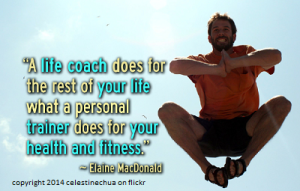
 When stopping to consider the future, many get bogged down and overwhelmed with the possibilities. With career choices, schooling, and personal changes all to be looked into, choosing just a single path is almost always the most difficult step. With the help of an outside perspective, however, those choices can not only become easier to make, but become clearer as to how they fit into your future.
Friends and family members often make a good sounding board, but can actually have too much information. Not only do they know your dreams and ambitions, they know everything about your past. Which is why an outside, unbiased source is the best stop toward finding your future. With the help of an experienced life coach you can not only earn some much-needed advice, but get started on a researched plan to help get you where you need to be. Without all the second guessing.
So, do you need a life coach?
If you have problems making decisions, are not where you’d like to be personally or professionally, or are just looking for some outside advice, a life coach may be the solution you’ve been looking for. They also specialize in helping others – whether in relationships, schooling, jobs, etc. – so you can be sure to find the perfect fit for your specific needs.
Working with a life coach also allows you to create a customized plan for your own life. Rather than placing people into categories, these coaches talk with you, ask questions, and more, in order to find the best path to meet your projected outcome.
Life coaches specialize in:
• Helping healthy, but not necessarily satisfied, people expand their horizons
• Allowing you to find the way to meet your own goals
• Creating a more fulfilled life, in a number of areas
• Helping you move forward with life and get “unstuck”
No matter if you think your life needs a little bit of coaching or a full-on overhaul, a life coach can help you work through whatever issues may arise. Together with their help you can create a happier, healthier life.
To learn more today, contact us or read our classes page.
 Most client couples prefer to focus on their intimate relationship, but many still contact us for help for the entire family. We ask that children be at least in their teens, our focus with families is the parenting as well as the marriage relationship. We believe that a stable marriage creates a critical foundation for a strong family.
 During elections, a common miss-perception among voters is that if the “other” party wins, life is bound to become downright miserable. People put a great deal of stock in their emotional beliefs about what is good and what is bad, often without a realistic interpretation of past, impending, or future results. The reality is that once the election is over, the doom and gloom many people expect rarely materializes. This does not apply to elections only, as a life coach and marriage counselor, I see this sort of negativity many other aspects of people’s lives, including marriage, family, and relationships. In the following article by author Steve Johnson we’re asked to assess the state of a number of indices of everyday life. Surprisingly, we tend to see life quite negatively, despite the reality. Before you read on, ask yourself, “Are you living the good life?”
 How does it work?
 Probably the most important couple counseling technique any counselor can use is empathy, the ability to sense and understand what each person is experiencing and feeling throughout the relationship. Without empathy a coach will be distant, the opposite of what is required to gain a person’s, or a couple’s, trust. With trust a couple will find themselves sharing both their darkest secrets and deepest needs, thus giving the counselor the most relevant information needed to best guide them forward.
 The third most important tool is a willingness to be firm and direct while maintaining compassion and consideration. Knowing that a coach isn’t a 90lb weakling strongly reinforces a persons confidence in him. At the same time, knowing he cares and is considerate makes it easier to deal with painful factors, rather than avoid them.
 The point about my client is that her awareness of emotional immaturity is very beneficial to her and can lead her to make changes to live a more fulfilled life and better relationships. Her past is certainly affecting her current outcomes, but it doesn’t need to define her future. Merely saying she want to change isn’t sufficient either, she needs to take action which will help her increase her emotional maturity.
 You keep repeating yourself.
 Put yourself in the other person’s shoes.